O'Neill made technical claims under oath, and the board said it will need expert evidence behind them
If you watched the October 15 livestream, you saw O'Neill take the witness chair while his attorneys presented the applicant's case. His testimony covered noise, lighting, water, power, jobs and tax revenue, and he also addressed air emissions under oath, including a claim of a 98 percent reduction or removal and a discussion of fuel cells. Opposing counsel challenged his qualifications to make those claims and the basis for them (recording, 2:23:36).
The board's solicitor recognized the same gap. During the discussion of the project's fiscal impact, he said the board understood the limits of general testimony and would need the supporting expert evidence (2:32:12). That's the right instinct, and it matches what we've been asking for all along. The record isn't complete until the studies behind each technical claim, and the people who prepared them, have been examined.
A figure like 98 percent can't be judged until you know which pollutants it covers, what baseline it's compared against, and at what operating loads and with which controls. Fuel cell claims need the same detail, since the U.S. Department of Energy notes that reforming hydrocarbon fuels releases carbon dioxide, though less than combustion engines do.
It also helps to be precise about who has to prove what. Under Plymouth's ordinance, the applicant must show the use falls within the special exception provision and that allowing it won't be contrary to the public interest. When the board or an opposing party puts specific public interest effects in issue, the applicant has to present credible evidence on those disputed points (§ 2101(D)). Objectors carry a burden too. Pennsylvania courts have held that objectors must produce evidence, that generalized fears and speculation aren't enough, and that the showing concerns a high probability of substantial harm beyond what that kind of use normally brings (Quaker Valley School District v. Leet Township ZHB, 2024). So the board should identify the standards at issue and require a record good enough to decide them, and opposing parties should bring their own evidence and targeted cross-examination.
Credentials and an oath aren't the whole question either, since a specialist retained by the applicant is usually paid by the applicant. What matters is the witness's relevant expertise, data, methods and assumptions, and whether those can be tested through questioning, which zoning hearings allow under the Municipalities Planning Code (§ 908). For noise, that means a qualified acoustical consultant or engineer with relevant experience who can walk the board through the study and answer for it.
| Topic | Who addressed it Oct 15 | Evidence to request |
|---|---|---|
| Emissions | O'Neill; opposing counsel challenged his qualifications and the basis for the claims | An emissions inventory and dispersion analysis for the current equipment, explained by the responsible specialist |
| Power & grid | O'Neill described interaction with the grid; his attorney said the client would not use turbines | A reconciled power and equipment schedule for each phase |
| Water | O'Neill, including an initial tank fill and other water uses | A complete water balance, from initial filling to landscaping |
| Noise | O'Neill | The revised study's author, with the current equipment list, mitigation and a plan to verify performance after installation |
| Lighting | O'Neill | A photometric plan showing light levels at the property line |
| Jobs & taxes | O'Neill; the solicitor said the board would need supporting expert evidence | The author of the applicant's fiscal study, available for questions on its assumptions |
The power plant has been described several ways, and the record needs one reconciled schedule
Earlier descriptions of the project, including O'Neill's own statements reported by The Inquirer in August, said the site would make its own electricity with natural gas turbines. At the October 15 hearing, the applicant's attorney said his client would not use turbines (1:12:28). That statement doesn't settle the final engineering design, but it does mean nobody should keep describing turbines as the current plan without qualification, and that includes us. Until the applicant says what the equipment is, we'll call it proposed on-site power generation.
The revised noise study filed August 26 is the most concrete description on file. Its equipment list includes 86 natural gas generators rated at 2.5 MW each, described as reciprocating engines inside a microgrid building, along with 208 diesel backup generators and 227 rooftop chillers rated at 850 tons. Multiplying 86 by 2.5 MW gives 215 MW for that modeled set of gas generators. That's arithmetic on the study's own list, and it doesn't tell you the campus's total demand or how much would run at once, since the study modeled a set maximum number of generators running together and calls all of its equipment data preliminary. The study itself also refers to turbines in a few places, which is one more reason the applicant should say plainly which configuration is current.
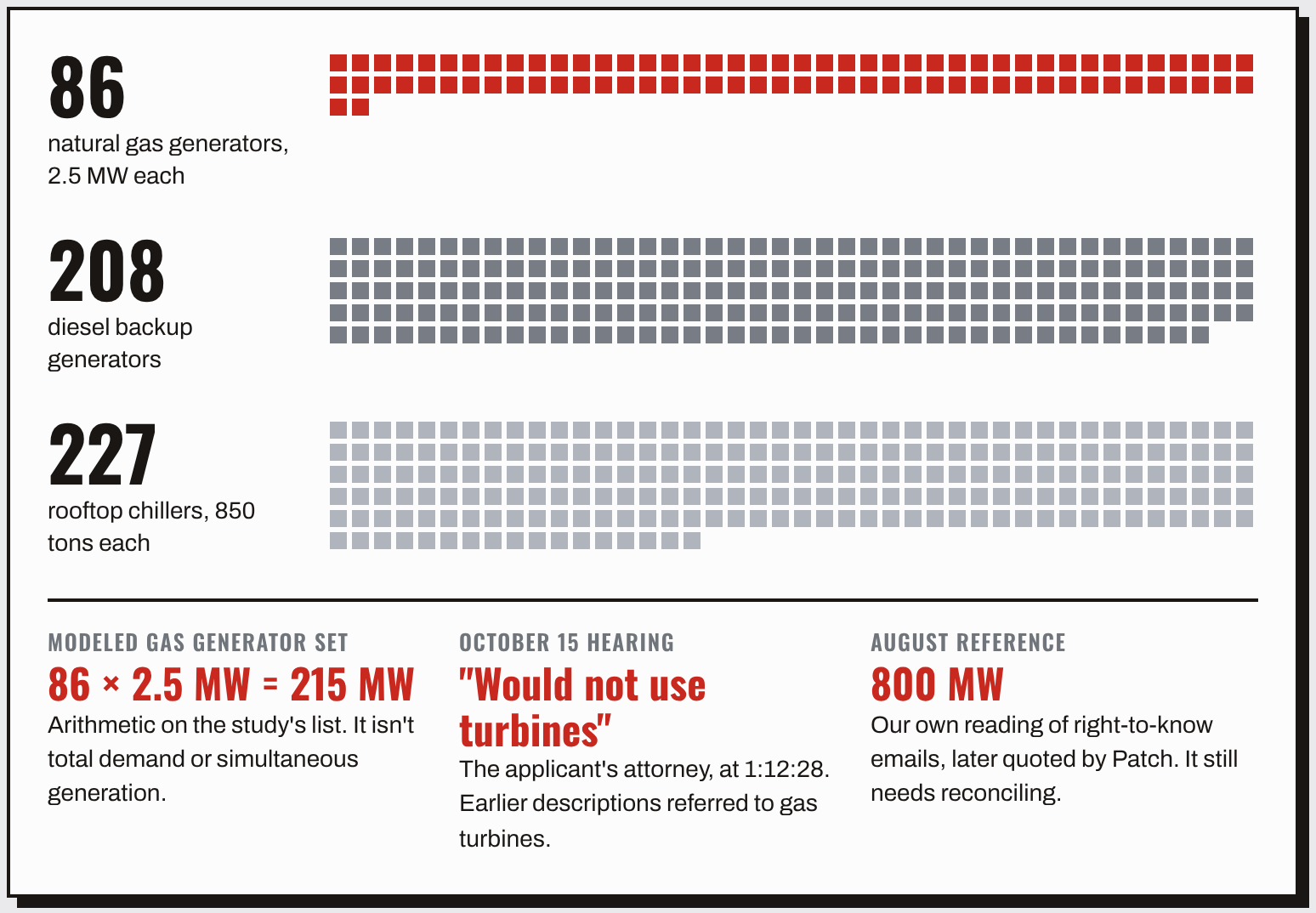
We also need to be straight about our own figure. In August we pointed to an 800-megawatt reference in right-to-know emails, and Patch's August 6 story quoted our Facebook post about it. That means the number rests on our reading of those records, and nobody has independently confirmed what it measured. The underlying email should be public, with its date, sender, recipient and the scope of the figure, and we'll post it. Either way, the applicant should reconcile that historical reference with the equipment in the revised study and say which figures describe the current proposal.
The cleanest fix is a power and equipment schedule for each phase of the project that separates these figures:
- IT equipment load
- Total facility load
- Installed generation capacity
- Generation during normal operations
- Backup generation
- Grid imports and exports
The last line matters because O'Neill described interaction with the grid during the hearing (2:29:15). It also raises a zoning question. The applicant cited the Montgomery and Chester County planning commissions' April 2026 Data Center Ordinance Guide at the hearing (44:08), and that guide recommends treating power generation that supplies a data center during normal operations as a separate principal use. The guide is advisory and doesn't decide what Plymouth's ordinance requires, but it supports a fair question for the board: how does Plymouth's ordinance classify the proposed primary power generation, and what approvals would that use need?
Water deserves the same treatment. The October 15 discussion included an initial tank fill and other water uses beyond cooling (2:25:34). The board should ask for a complete water balance covering initial filling, routine cooling, maintenance and replacement, bathrooms and other domestic uses, landscaping, and any other process or site demands, under this proposal's actual design and operating conditions.
The revised noise study is preliminary, and its compliance depends on mitigation that's still being designed
The August 26 study replaced a July 30 version. In a letter to the township manager dated the same day, O'Neill explained that 1027 Conshohocken Road, labeled Tract 2, shouldn't have been in the first report, writing that "we do not have the property under agreement and it was included erroneously in the report." Fixing that was the right call.
The revised study is candid about its limits. It says it "does not contain detailed solutions or final assessments" and calls its equipment sound data preliminary. Without added mitigation, it says, sound levels aren't expected to meet the township's residential or commercial limits. Compliance depends on attenuation, and for several sources, including the chillers, radiators and generator exhaust, the study says the needed attenuation goes beyond typical commercially available products and calls for custom engineered solutions. Page 6 also refers to a 5-decibel nighttime adjustment while the ordinance text the study quotes specifies 6 decibels. That may be a drafting error, and it doesn't by itself prove the model used the wrong limit, but it needs an explanation on the record.
The stronger request is for the current equipment list, the modeled operating conditions, the applicable octave-band limits, the required mitigation, and a method for verifying performance after installation. Daytime and nighttime readings near homes are useful for establishing today's conditions, but on their own they can't show whether a future facility would comply. The record should connect baseline measurements, source assumptions, operating scenarios, mitigation and post-installation checks.
Montgomery County joined the case and told the board its quarry is off the market
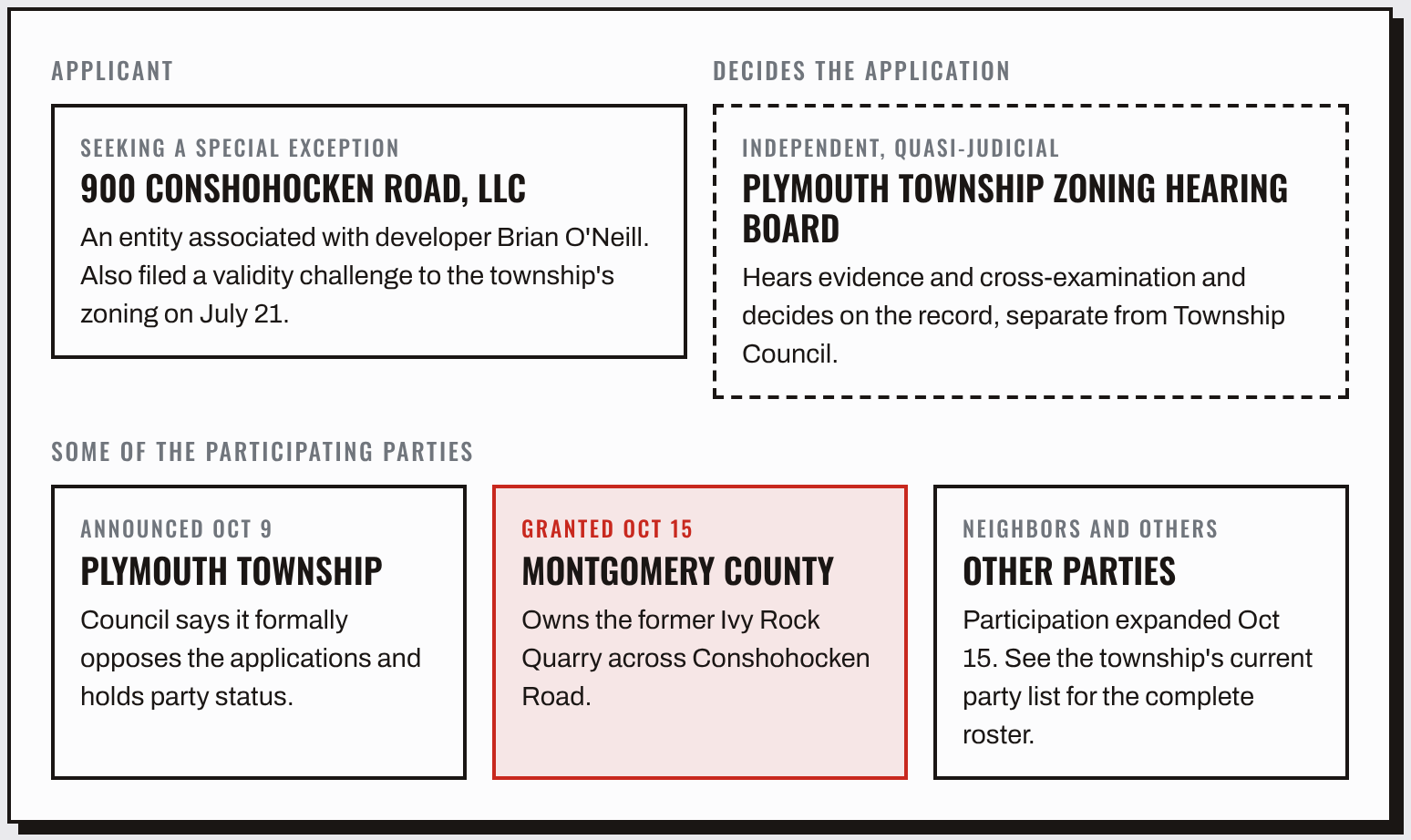
The board granted Montgomery County party status on October 15. The county owns the former Ivy Rock Quarry across Conshohocken Road from the mill site and asked for party status on that basis in September. The county had listed the quarry for sale earlier this year, and at the hearing its solicitor told the board the quarry had recently been taken off the market (45:25). The applicant's attorney asserted that his client had been the highest bidder, which the county's solicitor didn't confirm in that exchange. Residents should now ask what uses the county is considering for the quarry and how those plans inform its position on the data center next door.
The township is a party too. At its first Council Connect session on October 9, Vice Chair Kristin Frederick Leonard said the council "has formally opposed the applications and has requested and received party status in the zoning hearing board proceedings." The township's opposition is separate from the Zoning Hearing Board, which is an independent quasi-judicial body that decides the application on the record. Participation also expanded on October 15, and the board gave instructions about new parties at the end of the hearing (2:58:37), so the township's current party list is the place to check the full roster.
County party status doesn't decide the case, and the county planning guide the applicant cited, which recommends allowing data centers in heavy industrial districts as a conditional use, neither endorses nor rejects this project. The question remains whether this site, with Connaughtown homes just across Conshohocken Road, meets Plymouth's special exception standards.
Another O'Neill proposal has surfaced across the river, and nobody has said who will look at the combined effects
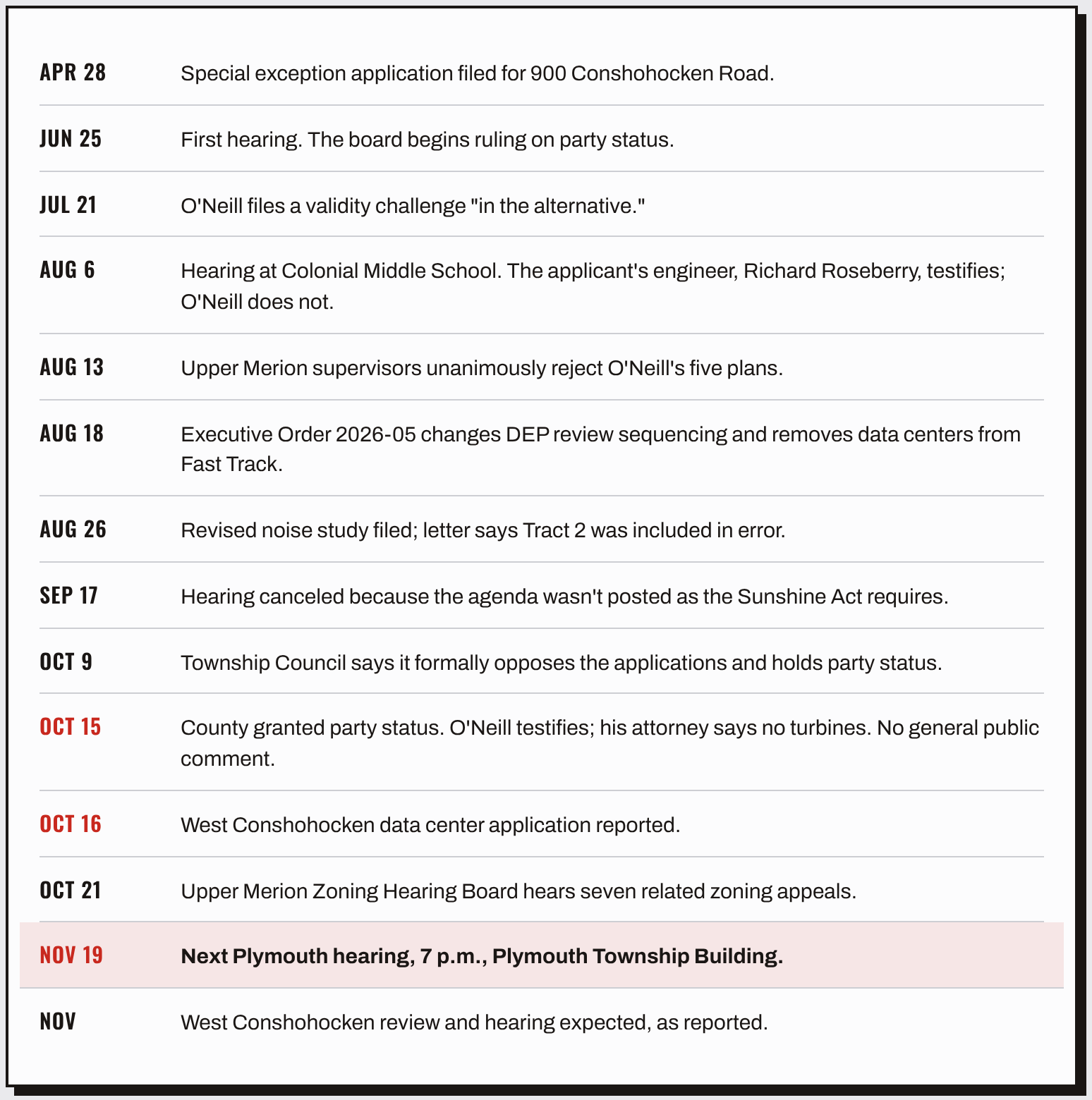
On October 16, MoreThanTheCurve reported that Innovation 411 Fee Owner, LLC, an entity associated with O'Neill, has applied for conditional use approval for a data center in West Conshohocken. The property runs along Front Street at the Upper Merion border, slightly downriver and across the Schuylkill from the steel mill, and it was once a quarry, a cement plant and a municipal solid waste disposal site. He's asking the borough to amend a 2023 approval for a life sciences campus to allow a data center campus with primary and backup generators, gas fuel cells and electrical substations. According to the report, the borough council's September 8 minutes say a planning commission review and conditional use hearing are expected in November.
In Upper Merion, the Board of Supervisors unanimously rejected O'Neill's five data center plans on August 13, and he has since filed lawsuits in the Montgomery County Court of Common Pleas asking a judge to reverse those denials, The Inquirer reported on September 18. Separately, the Upper Merion Zoning Hearing Board is scheduled to hear seven related zoning appeals on Wednesday, October 21 at 7 p.m. in Freedom Hall, according to the township's agenda. Those appeals are distinct from the land development applications and the court cases.
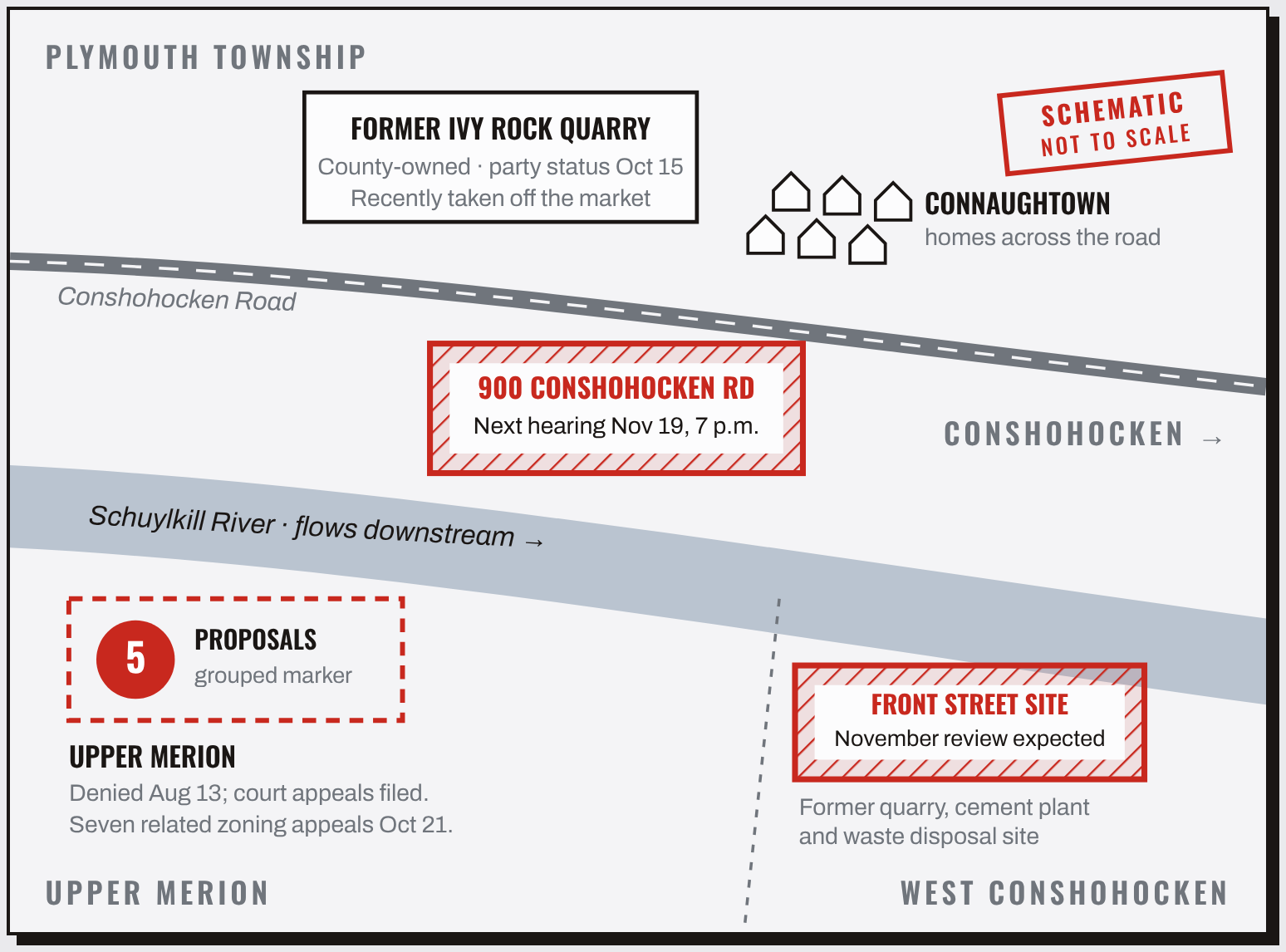
Local zoning standards can address effects on neighboring properties and public facilities, so no board is limited to looking inside the fence. Still, these proposals are moving through separate municipal proceedings, and residents need to know who will assess their combined noise, emissions, fuel demand and emergency-service needs across municipal boundaries. That's what we mean when we say we don't want a data center alley here, and it's a fair question to put to the applicant on November 19.
Whoever the tenant turns out to be, the commitments have to be enforceable
O'Neill told The Inquirer in August that he's "negotiating with multiple large tenants" and has indicated they'd be related to life sciences. The same week, he told WHYY News he was in discussion with a top five technology company. The more useful question for the board is whether an operator or tenant has been selected, and what obligations will apply regardless of who occupies the building.
For any commitment that matters, residents should be able to get answers to a few practical questions:
- What is the exact limit or operating condition?
- Which document records it?
- Who verifies compliance?
- How will complaints and possible violations be investigated?
- Will the obligation continue after a change in owner, operator or tenant?
Not every condition is the Zoning Hearing Board's to impose, so each request should be tied to the ordinance, a permit, an agreement or some other source of authority.
State permits are part of that picture. Governor Shapiro's Executive Order 2026-05, signed August 18, removed data center projects from the state's Fast Track program and changed the sequencing of Department of Environmental Protection review for qualifying new applications, meaning those submitted after August 18 for projects with peak demand above 25 MW. The route depends on whether the developer signs a binding GRID consent order and agreement. Signers can get rolling review but need documented local approvals before permits are issued, while non-signers need local approvals before DEP begins its review. The order's ban on nondisclosure agreements applies to agencies under the governor's jurisdiction, so it doesn't by itself reach a private tenant agreement. DEP's October 7 tracker file listed this project as proposed with no applications received, and we'll ask DEP which route applies, which applications are pending and which local approvals remain necessary.
The township should put the validity challenge's status in writing
On July 21, O'Neill filed a substantive validity challenge to the township's zoning "in the alternative" to his special exception application, as MoreThanTheCurve reported on July 29. As of October 18, after reviewing the township's data center information page and the Zoning Hearing Board agendas posted there, we haven't located a public update on it. A missing agenda item doesn't prove anything about the challenge's legal status, which is exactly why the township should post the operative filing date, any extension, any hearing notice, and any decision or other disposition.
On public comment, township officials have said it will begin after the evidentiary hearings conclude and will be held at a larger venue. At the end of the October 15 session, the board announced the next hearing for November 19 at 7 p.m. at the Plymouth Township Building (2:59:11). That announcement didn't promise general public comment that night, so we'd ask the township to announce the comment date and venue as early as it can.
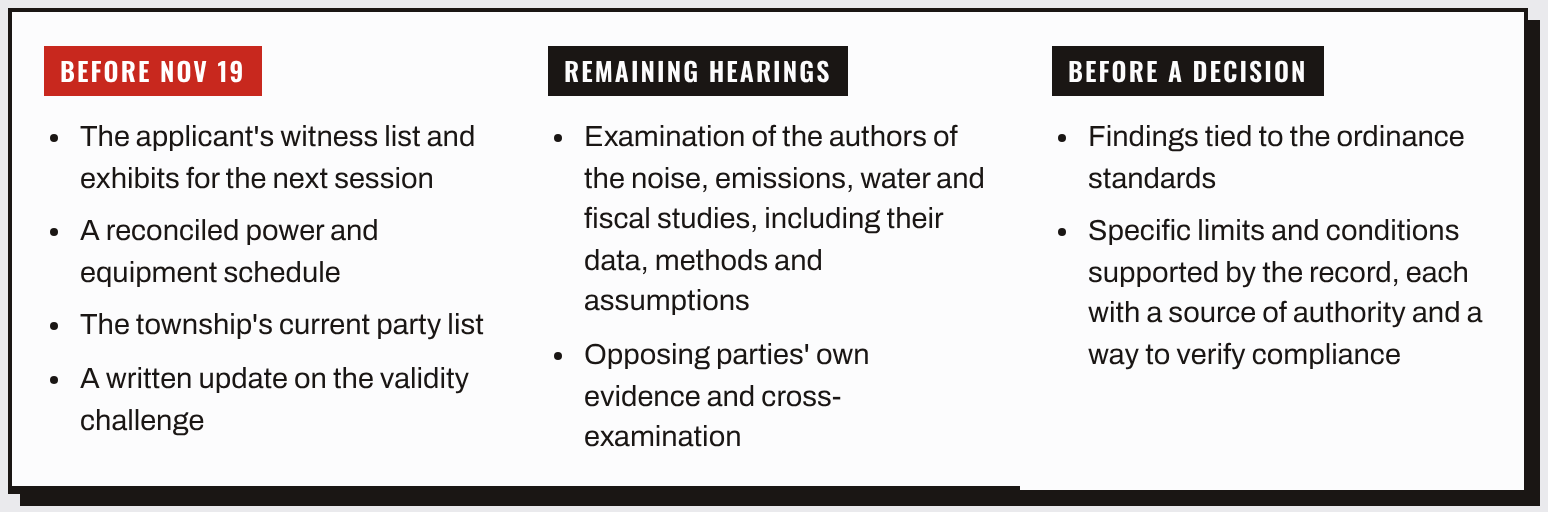
What we're asking for, stage by stage
Not everything has to be settled before the next hearing, but the record should be complete before anyone votes. Here's how we'd break it down.
Sources
October 15 hearing recording
- Plymouth Township Zoning Hearing Board, official recording, October 15, 2026. link. Passages cited: applicant raises county guidance (44:08), county on quarry sale (45:25), attorney on turbines (1:12:28), emissions and fuel cells (2:23:36), water (2:25:34), grid (2:29:15), general testimony and expert evidence (2:32:12), new parties (2:58:37), next hearing (2:59:11). Timestamps follow the recording's automatic captions, which aren't a certified transcript.
Official documents, law and technical sources
- 900 Conshohocken Road, LLC, Preliminary Environmental Noise Assessment (Auxia Design), revised August 26, 2026. link
- 900 Conshohocken Road, LLC, letter to Township Manager Matt West, "Clarification of Auxia Design Environmental Noise Assessment inclusion of 'Tract 2' - 1027 Conshohocken Road," August 26, 2026. link
- Plymouth Township, "900 Conshohocken Road Data Center Information," accessed October 18, 2026. link
- Plymouth Township Zoning Ordinance, § 2101(D), Standards of Proof. link
- Pennsylvania Municipalities Planning Code, § 908. link
- Governor Josh Shapiro, Executive Order 2026-05, "Protecting Pennsylvania Consumers from Data Center Impacts," August 18, 2026. link
- Pennsylvania DCED, "GRID Requirements." link
- Chester County and Montgomery County Planning Commissions, Data Center Ordinance Guide, Version 1.0, April 2026. link
- Upper Merion Township, Zoning Hearing Board agenda, October 21, 2026. link
- Quaker Valley School District v. Leet Township Zoning Hearing Board, Commonwealth Court, January 26, 2024. link
- South Bethlehem Associates v. Zoning Hearing Board of Bethlehem Township, Pennsylvania Supreme Court, May 16, 2023. link
- U.S. Department of Energy, "Fuel Cell Systems." link
Reporting
- 6abc Philadelphia (WPVI), Leland Pinder, "Plymouth Township data center proposal sparks contentious zoning hearing," October 16, 2026. link
- FOX 29 Philadelphia, Shawnette Wilson, "Plymouth Township data center plan draws neighbor concerns over noise, emissions," October 16, 2026. link
- Citizen Portal, "Plymouth Township Council says it opposes proposed data center at 900 Conshohocken Road," October 9, 2026. link
- MoreThanTheCurve, Kevin Tierney, "Developer Brian O'Neill seeking conditional use approval for data center in West Conshohocken," October 16, 2026. link
- MoreThanTheCurve, Kevin Tierney, "Plymouth Township's council released a statement on data center application. See what questions they chose not to answer," June 11, 2026. link
- MoreThanTheCurve, Kevin Tierney, "Data center developer submits substantive validity challenge to Plymouth Township in connection with proposed data center," July 29, 2026. link
- The Philadelphia Inquirer, Frank Kummer, "Rowdy residents at Plymouth Township zoning meeting draw rebukes as they push back on big data center plan," August 7, 2026 (updated August 8). link
- The Philadelphia Inquirer, Erin McCarthy, "Developer sues Upper Merion Township over rejected King of Prussia data center proposals," September 18, 2026. link
- WHYY, "Plymouth Township, Conshohocken-area residents shout, boo, as hearing for data center begins," August 7, 2026. link
- Patch, Justin Heinze, "Major Data Center Hearing In Plymouth Twp. Thursday Night: What To Know," August 6, 2026. link
The DEP tracker status comes from the Department of Environmental Protection's Data Center Permit Tracker file dated October 7, 2026. This post states our opinion and asks questions. What happened at the October 15 hearing comes from attending and watching it, with recording timestamps where we cite specific statements. Where we quote someone or rely on another outlet's reporting or analysis, we've credited the recording, the filing or the outlet.