Summary
Two former power sites along the Schuylkill, Barbadoes Island and Cromby near Phoenixville, are among 21 locations Pennsylvania is examining for energy redevelopment. The study does not approve a new plant or commit either site to gas generation. Its next phase, however, is intended to narrow the list to five to seven priorities. Before that happens, you deserve three things: reliable site data, an early look at the environmental tradeoffs, and a clear explanation of which costs could reach your utility bill. The preliminary report falls short on all three. Its Barbadoes distance column repeats another site’s figures, its analysis leaves out future air emissions and water use, and it does not explain how existing consumer protections would apply to each redevelopment option. Written comments on this phase close Wednesday, October 14. Ten days remain.
Two of the 21 sites sit on our stretch of the river
Barbadoes Island is about three miles in a straight line from 900 Conshohocken Road. Cromby is about twelve. A third PATER site, listed in the report as Jefferson Smurfit Corp JSC on Venice Island in Philadelphia, is five to six miles downriver.
↑ See all three on the map at the top of this page, with a profile for every site
That matters here because of what is already proposed at 900 Conshohocken Road. The applicant’s revised preliminary noise assessment, dated August 26, lists 86 natural-gas generating units rated at 2.5 MW each and 208 diesel backup generators. Those numbers describe a proposed design that the assessment itself says remains subject to change. Even so, they make the possible reuse of nearby power sites a local question, and a question for you.
What the study does, and what is still undecided
The report is called Statewide Transmission and Energy Redevelopment Analysis for the Commonwealth of Pennsylvania, Part A: Preliminary Assessment of Potential Opportunities. KeyLogic Systems prepared it with the Electric Power Research Institute, in coordination with Team PA and the Pennsylvania Public Utility Commission. It is publicly funded, with support acknowledged from the PUC, Team PA and the U.S. Department of Energy.
Part A screens 76 retired plants down to 21 candidates for further redevelopment analysis. Part B is meant to narrow those to “5–7 priority redevelopment locations.” The report looks at several generation technologies, at large electricity users including data centers and manufacturing, and at combinations of the two. It says it is “not intended to be prescriptive of the end use for each site.”
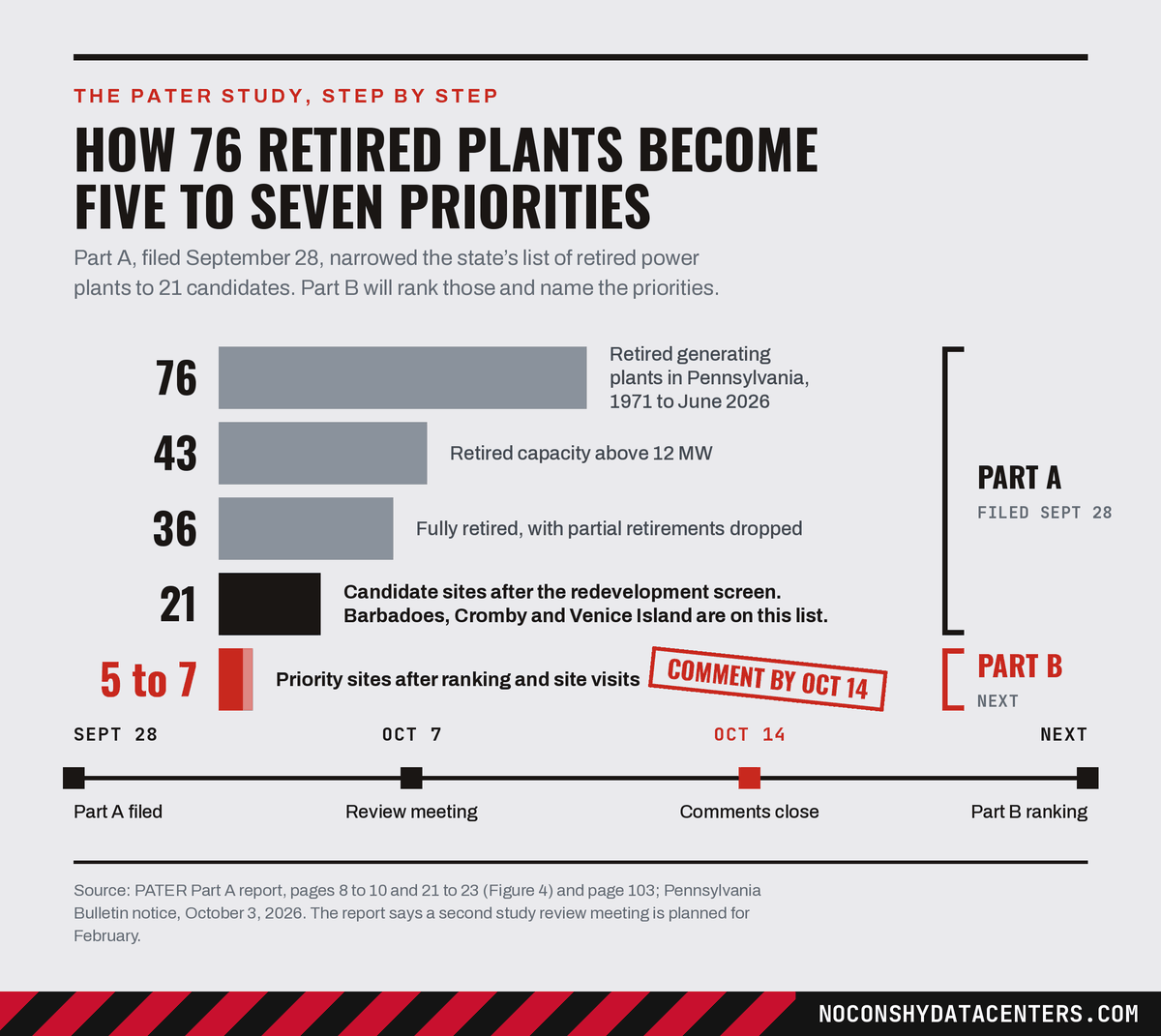
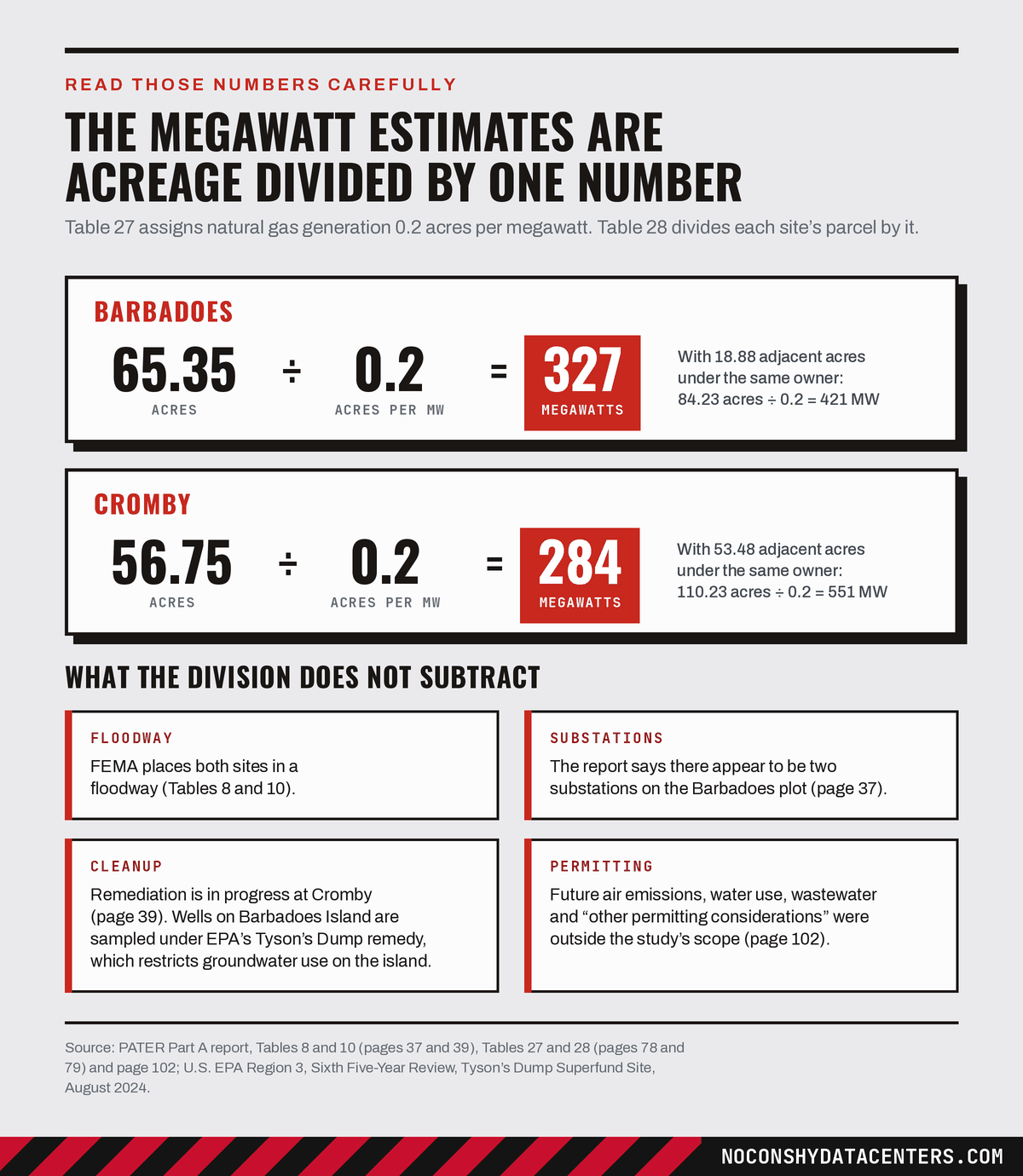
Here is how our two sites got sorted. The study places PECO-area sites in its generation category because projected demand growth there exceeds planned generation additions. Its acreage-based estimates on page 78 put Barbadoes at 327 MW of gas, or 421 MW counting adjacent land under the same owner, and Cromby at 284 MW, or 551 MW with adjacent land.
Reusing old industrial sites and adding dependable power can offer real public benefits. More supply can ease pressure on a tight regional grid. Those benefits should be demonstrated alongside the local costs before the state names its preferred locations, and Part B is where that has to happen.
The Barbadoes distance column appears to have been copied from another site
Table 7 on page 36 covers the Armstrong Power Station in Armstrong County, more than 200 miles west. Table 8 on page 37 covers Barbadoes. All ten entries in the Barbadoes distance column repeat the Armstrong figures exactly, and several contradict the Barbadoes narrative printed right above the table.
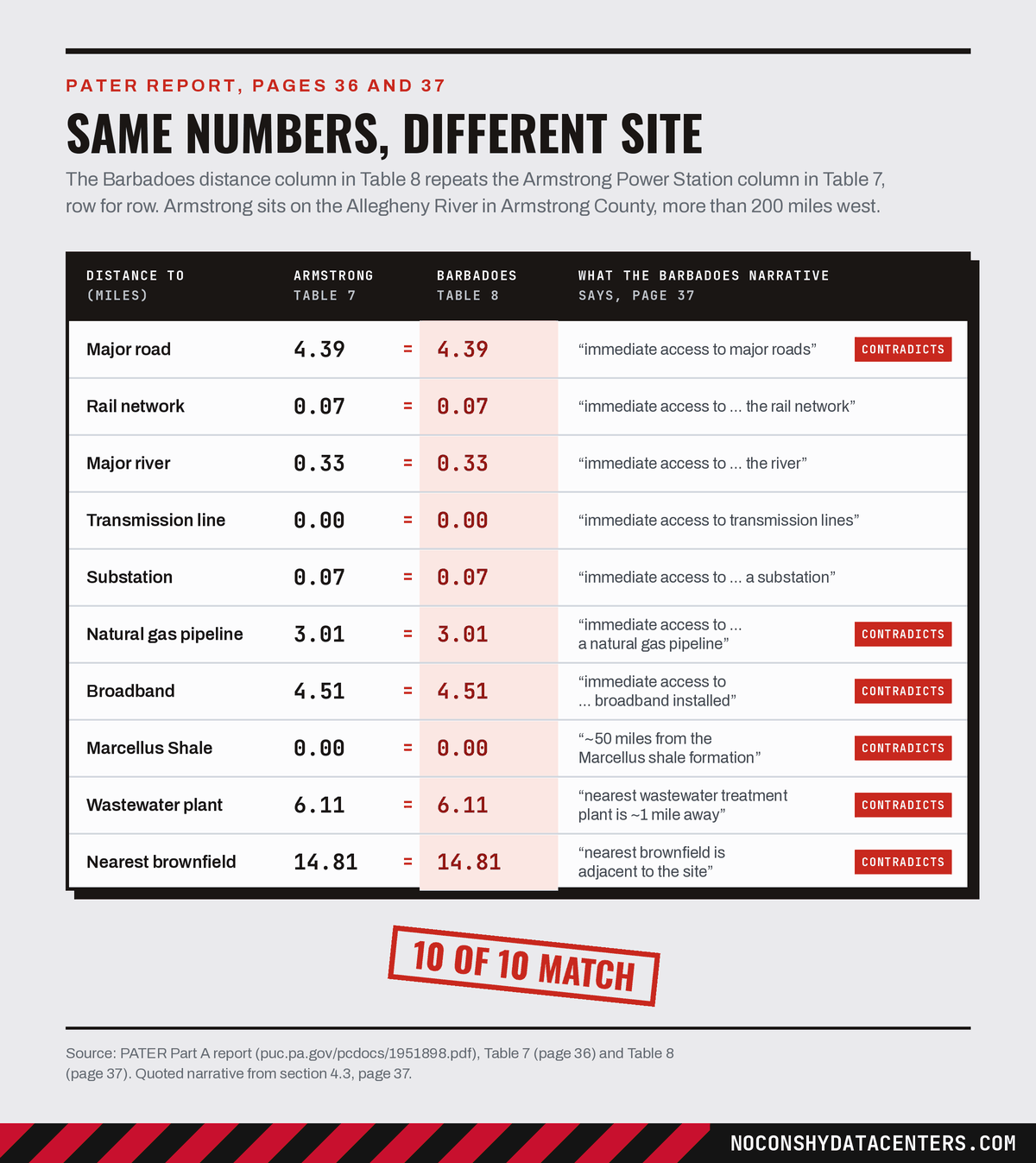
The duplication also appears in the version of the report linked from the PUC’s study page. It doesn’t prove which underlying values the consultant’s database holds, or whether the error has touched any scoring yet. The report does say these attributes feed the Part B ranking. The PUC should publish corrected distances for Barbadoes and explain which values Part B will use.
Future air and water impacts should inform the shortlist
The report documents existing conditions at each site. What it sets aside is what a new plant or facility would add. Page 102 says it plainly:
“Because the study focuses on redevelopment viability rather than specific redevelopment pathways, potential environmental impacts associated with future end uses, such as air emissions, water use, wastewater generation, and other permitting considerations, were outside the scope of this assessment.”
PATER Part A report, page 102
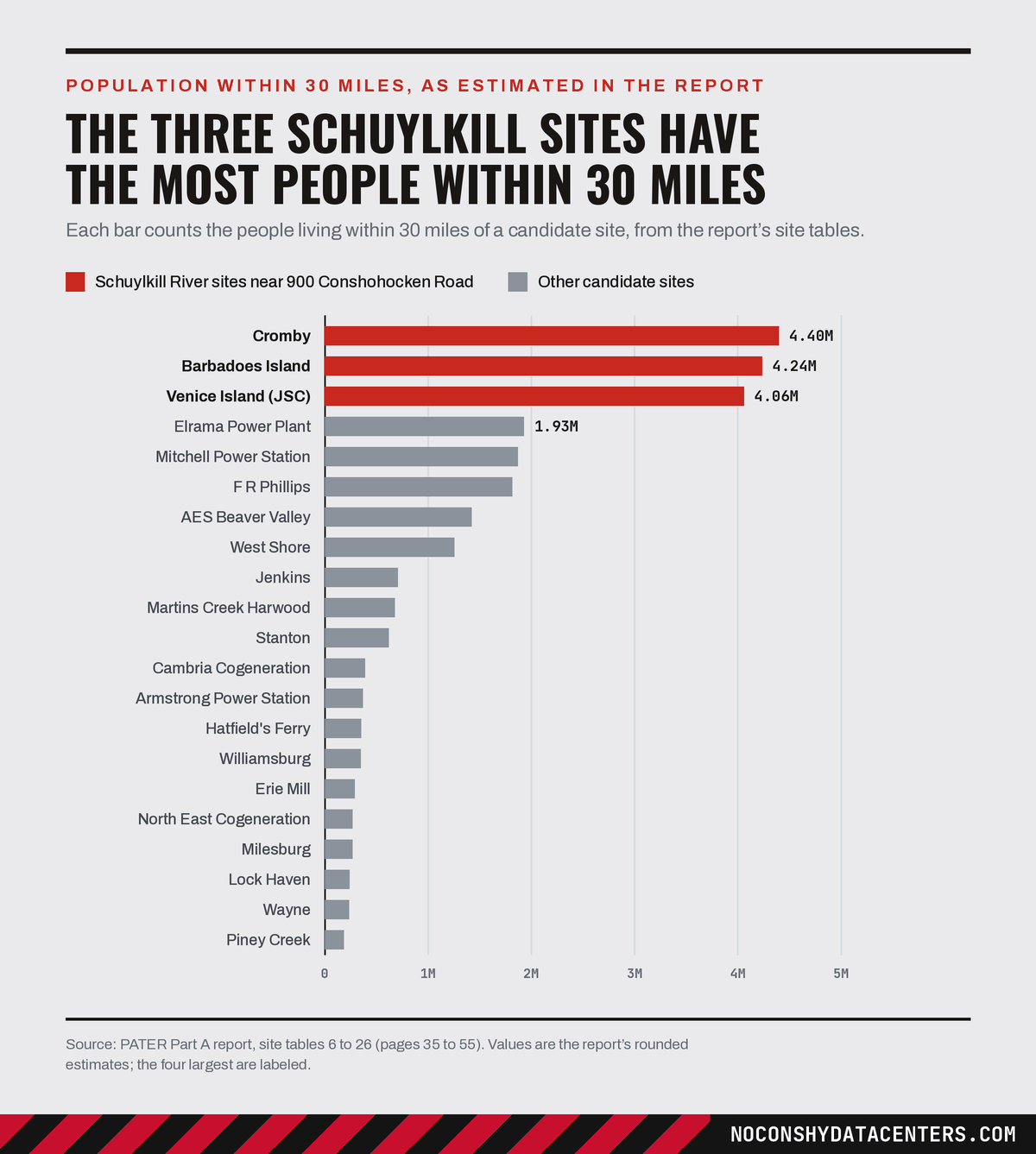
The report estimates about 4.4 million people within 30 miles of Cromby and 4.2 million within 30 miles of Barbadoes, the two largest totals among the 21 candidates. A 30-mile circle is a population count and not a pollution model, but it tells you how many people live near these choices. If emissions and water use only get studied after Part B names its priorities, the shortlist will already carry the state’s weight. We think those questions belong in the ranking itself.
The sites also carry their own complications. The report flags floodway conditions at both, and it reports confirmed groundwater contamination at Barbadoes. EPA records tie contaminated groundwater beneath the island to the nearby Tysons Dump Superfund site, where treatment and monitoring continue and groundwater use on the island is restricted. EPA’s most recent review found the remedy protective in the short term. Any redevelopment review should explain how construction would interact with that cleanup, its monitoring wells and those restrictions.
Then there is the combined picture. Air permitting can account for nearby sources, and the Governor’s August executive order directs DEP to examine how rules treat multiple generators at or near a facility. Different approvals address different pieces. What you still lack is one public assessment of how the river-corridor proposals and these candidate sites, taken together, could affect air, water, noise and nearby neighborhoods. Who will publish that picture before individual projects gather momentum?
Explain which costs could reach your bill
The report opens with a number every PECO customer feels. It says average prices for Pennsylvania residents rose 46.1% from 2018 to 2025. It also notes that PJM’s latest capacity auction cleared short. PJM’s July auction for 2028-29 left a 6,831-megawatt gap against its reliability requirement. When new data center demand outpaces dependable supply, regional capacity costs can rise, and some of that reaches household bills.
You don’t start from zero on protections. In May the PUC adopted a model large-load tariff framework built on cost-causation principles, so that large customers are responsible for the infrastructure and interconnection costs they cause, with deposits and collateral to guard against stranded costs. That framework guides future utility tariff filings. The August GRID executive order also changed permitting procedures for large data centers.
The PATER report doesn’t explain how any of that would apply to its redevelopment options. A data center connecting to PECO, a power plant selling into PJM, and a shared gas lateral all fall under different arrangements. Part B should say, option by option, who finances generation, interconnection, transmission and gas upgrades, which costs could reach other customers, and who absorbs the loss if a project is delayed, downsized or abandoned.

Community concerns need to shape the ranking
The report lists “community acceptance and social license” among its primary risks and cites opposition at Homer City. On page 102 it records what residents there raised: “potential air quality impacts, competitions for water resources between data centers and residents, uncertainty surrounding economic benefits and job creation.” Those concerns belong inside the ranking criteria, ahead of Part B’s choices.
The access limits deserve attention too. The comment window runs September 28 through October 14, and the formal notice appeared in the Pennsylvania Bulletin on October 3. Filing requires a PUC eFiling account. The review meeting is a weekday session in Harrisburg with limited seating. The PUC should extend the window and hold evening meetings in Montgomery and Chester counties before Part B narrows the list.
The report also thanks Kevin Sunday of McNees Government Relations alongside agency and Team PA staff. The PUC should explain the role of each outside contributor and disclose any relevant client interests or conflicts it considered in preparing the study.
How to weigh in this week

-
File a comment by October 14. The notice directs residents to file under Docket M-2026-3059601 through the PUC’s eFiling system at puc.pa.gov/filing-resources/efiling. Filing requires an account and acceptance of electronic service. Comments are posted at puc.pa.gov/docket/M-2026-3059601. Cite the page, explain the problem, and request a specific correction or analysis. Pick any of these:
-
Watch the October 7 study review meeting. It streams at puc.pa.gov/live-streaming. The notice provides for a presentation and panelist comments. Questions about the meeting go to Elizabeth Barnes at the PUC, ebarnes@pa.gov.
-
Ask your officials to file. Montgomery County announced that it has requested party status in our zoning case. Ask the commissioners, your township, your state representative and Senator Katie Muth, prime sponsor of SB 1359, the proposed Statewide Hyperscale Data Center Moratorium Act, to file on the PATER docket too. A county filing can put local evidence and specific requests into the formal record.
-
Back the PUC when it gets it right. On October 1 the PUC issued a tentative order (Docket M-2026-3064961) proposing a large-load registry and stronger curtailment procedures for eligible computational loads without sufficient incremental capacity. It would restrict critical-load protection for data centers, with a narrow exception for qualifying essential services. Comments will be due 30 days after publication in the Pennsylvania Bulletin. Tell the PUC to finalize it, and to carry the same principle into PATER: the load that creates the cost pays the cost.
-
Show up. Groups from across the state rally at the Main Capitol Rotunda in Harrisburg on Tuesday, October 6, at 12:30 p.m. Closer to home, the Plymouth Township Zoning Hearing Board resumes its evidentiary hearing on 900 Conshohocken Road Thursday, October 15, at 7:00 p.m. in the Karen B. Weiss Meeting Room, 700 Belvoir Road. Seating is limited, with priority for parties and participants, and the township will livestream to a viewing location at the Greater Plymouth Community Center. The township says public comment will not be taken that night and will be held later at a larger venue. Come anyway. A full room and a full overflow room tell the board who is watching.
October 14 closes this round of comments, and it is an early chance to shape the shortlist. Use it to ask for corrected data, real environmental analysis and a straight answer on costs before the list gets shorter.
Sources
- KeyLogic Systems, LLC and EPRI, “Statewide Transmission and Energy Redevelopment Analysis for the Commonwealth of Pennsylvania, Part A: Preliminary Assessment of Potential Opportunities,” Pennsylvania Public Utility Commission, filed September 28, 2026. https://www.puc.pa.gov/pcdocs/1951898.pdf
- Pennsylvania Public Utility Commission, “Pennsylvania Accelerated Transmission and Energy Redevelopment Study Review Meeting; Doc. No. M-2026-3059601,” Pennsylvania Bulletin, 56 Pa.B. 6599, October 3, 2026. https://www.pacodeandbulletin.gov/Display/pabull?file=/secure/pabulletin/data/vol56/56-40/1467.html
- PUC Docket M-2026-3059601. https://www.puc.pa.gov/docket/M-2026-3059601
- J. Brian O’Neill, 900 Conshohocken Road, LLC, “Clarification of Auxia Design Environmental Noise Assessment inclusion of ‘Tract 2’ - 1027 Conshohocken Road,” letter to Plymouth Township, August 26, 2026. https://www.plymouthtownship.org/download/Citizen%20Boards/zoning_hearing_board/2026/applications/2026_0826_Letter_900ConshohockenRoad_EnvironmentalNoiseAssessment.pdf
- Auxia Design, “900 Conshohocken Road Environmental Noise Assessment (Updated),” August 26, 2026. https://www.plymouthtownship.org/download/Citizen%20Boards/zoning_hearing_board/2026/applications/2026_0826_Document_900ConshohockenRoad_EnvironmentalNoiseAssessment_UPDATED.pdf
- U.S. EPA Region 3, “Sixth Five-Year Review Report for Tyson’s Dump Superfund Site,” August 2024. https://semspub.epa.gov/work/03/2389280.pdf
- U.S. EPA Region 3, “Fifth Five-Year Review Report for Tyson’s Dump Superfund Site,” September 2019. https://semspub.epa.gov/work/03/2282817.pdf
- Pennsylvania Public Utility Commission, “PUC Releases Final Order Establishing First-of-its-Kind Large Load Model Tariff Framework,” May 13, 2026. https://www.puc.pa.gov/press-release/2026/puc-releases-final-order-establishing-first-of-its-kind-large-load-model-tariff-framework-05132026
- Pennsylvania Public Utility Commission, “PUC Advances Consumer Safeguards as Data Center Growth Adds New Demands to Electric Grid,” October 1, 2026. https://www.puc.pa.gov/press-release/2026/puc-advances-consumer-safeguards-as-data-center-growth-adds-new-demands-to-electric-grid-10-1-26
- Pennsylvania Public Utility Commission, Tentative Order, Docket M-2026-3064961, October 1, 2026. https://www.puc.pa.gov/pcdocs/1952506.pdf
- PJM Interconnection, “PJM Capacity Auction Procures 138,318 MW of Generation Resources,” July 14, 2026. https://www.pjm.com/-/media/DotCom/about-pjm/newsroom/2026-releases/20260714-pjm-capacity-auction-procures-138318-mw-of-generation-resources.pdf
- Plymouth Township, “ZHB Special Meeting October 15, 2026.” https://www.plymouthtownship.org/zhb-special-meeting-october-15-2026/
- David E. Hess, “PUC Holds Oct. 7 Meeting To Hear Presentation On Recommendations For Grid Modernization To Develop New Electric Generation At 21 Deactivated Energy Sites To Support Large Loads,” PA Environment Digest Blog, October 2, 2026. https://paenvironmentdaily.blogspot.com/2026/10/puc-holds-oct-7-meeting-to-hear.html
- David E. Hess, “Sunday PA Environment & Energy Articles - NewsClips: 10.4.26” (calendar listing for the October 6 rally), PA Environment Digest Blog, October 4, 2026. https://paenvironmentdaily.blogspot.com/2026/10/sunday-pa-environment-energy-articles.html
- No Conshy Data Centers, PATER site data, compiled from the Part A report’s site tables. /data/pater-sites.json
Distances are straight-line estimates from the campaign map pin for 900 Conshohocken Road (40.0872, -75.3172) to the site coordinates published in the PATER report, rounded.